You will be asked to choose your contribution rate from the following options:
The CAAT Pension Plan
The CAAT Pension Plan, also referred to as CAAT, the CAAT Plan or the Plan, is a not-for-profit pension trust that provides defined benefit (DB) pensions to members across Canada.
CAAT is a Jointly Sponsored Pension Plan (JSPP), which means members and employers are equally represented on CAAT’s governing bodies: the Sponsors’ Committee and the Board of Trustees. Under this governance structure, member and employer representatives jointly participate in decisions regarding the administration and funding of the Plan.
CAAT manages a pool of assets funded by contributions from active members and employers, and the investment earnings on those contributions. The Plan's assets are overseen by professional investment and pension management teams, with funding and investment policies intended to support the long-term sustainability of the Plan.
CAAT Contact Centre
You can call CAAT at 416-673-9000 (GTA) or 1-866-350-2228 (toll-free) or send an email to member@caatpension.ca with your questions and inquiries. Identify yourself and your employer, and CAAT’s representatives will help you with your pension-related questions.
The Contact Centre operates Monday to Friday between 8:30 am and 4:00 pm.
My Pension Member Portal
Once enrolled, you’ll also have access to a secure online member portal called My Pension. Through the portal, you can view your annual statements online, manage your contact information easily, and receive an estimate by using retirement planning tools. You’ll also be able to send secure messages to CAAT Pension Plan staff.
The DBplus plan design
DBplus is a DB pension plan design offered through the CAAT Pension Plan. You and Molson Coors will each contribute a percentage of your eligible earnings to the Plan, and those contributions will be used to provide you with a lifetime pension at retirement.
Unlike a defined contribution (DC) plan, your pension is determined using a formula rather than the value of an individual investment account. See question 8 for details on the formula used to determine your pension.
Certain Plan features are subject to the Plan's funded status and Funding Policy.
Enrolment is mandatory for all Molson Coors employees who are members of CUBGW Local 325.
If you are a regular full-time or part-time Molson Coors employee who is a member of CUBGW Local 325, you will join DBplus on December 27, 2026 if you have completed your 90-day probation period. If you are still in your probation period at this time, you will join after your 90-day probation period is over.
If you are a casual, seasonal or temporary Molson Coors employee who is a member of CUBGW Local 325, you will join DBplus on the later of December 27, 2026 or the first day of the month coincident with or immediately following the date when you have either:
- Completed 700 hours of employment with Molson Coors; OR
- Achieved earnings from Molson Coors of at least 35% of the Year’s Maximum Pensionable Earnings, as identified by the Canada Revenue Agency (CRA)
in each of the two prior consecutive calendar years working at Molson Coors.
Contribution Choice | Your Contributions | Molson Coors’ Contributions |
Option 1* | 5.00% | 5.00% |
Option 2 | 6.00% | 6.50% |
Option 3 | 7.00% | 8.00% |
Option 4 | 7.50% | 9.00% |
*Default rate if no choice is submitted
Contributions for employees assigned to the W.E.C. will be adjusted to be equivalent to contributions for regular employees working on a forty (40) hour schedule as outlined in the CBA.
To choose your contribution rate, you will be asked to submit the Contribution Choice Election Form by December 9. You will have the opportunity to fill the form during the education sessions on November 19 and 20 and return it onsite to Sabrina Lévesque.
If you choose to complete your form at a later date, you can submit it by email to TotalRewardsCanada@molsoncoors.com or by mail to:
Molson Coors Benefits Team
111, Robert-Bourassa Boulevard, 9th floor
Montréal, QC
H3C 2M1
If you do not have a copy of the form, you can request one from HR.
Note that your previous contribution rate under the defined contribution component of the Molson Canada Pension Plan for Hourly Employees in Ontario and Atlantic Canada (the Molson Plan) (administered by Manulife) will not be carried over into the CAAT Pension Plan.
If you do not submit a valid form by the deadline, you will be enrolled at the default contribution rate of 5% with a matching contribution of 5% from Molson Coors.
Yes. You will be able to change your contribution rate on a quarterly basis during a designated election window.
Yes. By November 30 of the year you turn 71, you will have to stop contributing to DBplus and start collecting your pension by December 1 of that year, even if you continue working. This is a Federal Income Tax Act rule.
Your DBplus pension is calculated using a formula so that, when you retire, you can estimate the annual pension you will receive when you retire.
The formula is made up of two parts:
a) Annual Base Pension: The annual base pension is calculated at the end of each year that you and your employer contribute. The pension formula adds your contributions plus the contributions your employer makes on your behalf and multiplies them by a pension factor of 9.5%.
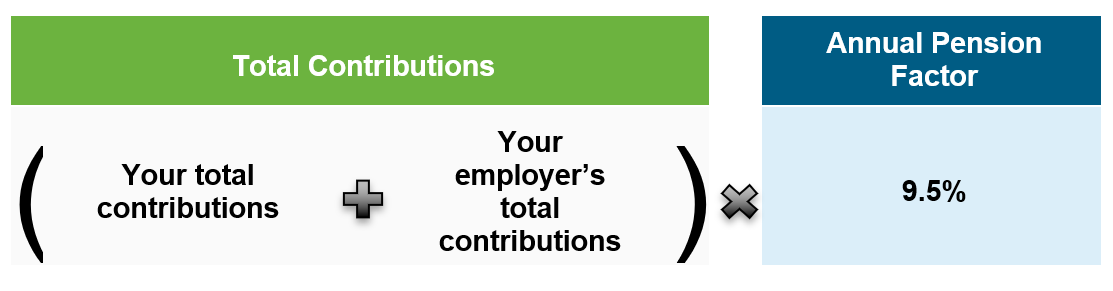
The Annual Pension Factor is subject to the CAAT Pension Plan Funding Policy. You can find the Funding Policy on CAAT’s website and at the bottom of this web page.
b) Conditional Average Industrial Wage (AIW) enhancements: At the start of each year in which you are a contributing member, AIW enhancements may be applied to the total pension you earned in DBplus to the end of the previous year, subject to the CAAT Plan’s Funding Policy. Calculated by Statistics Canada, AIW represents the growth in wages over time. Any amount that has been granted is a permanent increase to your pension that will not be reduced.
To learn more about the Funding Policy visit the Funding page on CAAT’s website.
No, CAAT does not have a vesting period. Once you’re enrolled, you are immediately vested.
Conditional inflation protection comes in two forms for DBplus pensions: Average Industrial Wage (AIW) enhancements applied to your benefits prior to retirement and inflation protection increases on your pension when you retire.
Conditional AIW enhancements grow DBplus pensions while a member works. At the start of each year, an AIW enhancement is applied to the total DBplus pension earned up until the end of the previous year. These annual AIW enhancements are based on the year-over-year percentage increase in Canada's AIW index, measured from July 1 to June 30.
In retirement, conditional inflation protection increases will be applied to pensions in pay to help protect the purchasing power of your pension. Inflation protection is applied annually at the beginning of each year. This is measured from September 1 to August 31 each year. The Plan has granted conditional inflation protection every year since 2007.
The decision to grant the AIW enhancement and inflation protection is made based on the funded status of the CAAT Pension Plan, according to its Funding Policy. Once granted, these benefits cannot be taken away.
AIW enhancements have been granted since the inception of DBplus. Historical AIW increases can be seen here.
Total employee and employer contributions to DBplus each calendar year are subject to Income Tax Act limits. This means contributions will stop when the Money Purchase limit is reached or contributions reach 18% of compensation, whichever comes first. This limit increases each year and is published by the Canada Revenue Agency (CRA).
You can use CAAT’s DBplus Pension Estimator to see an estimate of the starting annual pension at retirement and the value over your lifetime in retirement.
- Log into your My Pension account: member.caatpension.ca.
- Select “Estimate your pension” from the menu on the left side of your screen.
- Once you have read and agreed to the Terms of Use, click “Start”.
- Enter your date of birth, earnings, and enrolment date, then select “Calculate”.
You may change certain assumptions like your age or date of retirement. Remember to select “Calculate again” whenever you change an assumption.
Yes. Your DBplus pension contributions are tax-deductible. In addition, since your contributions are deducted from your income before taxes, this reduces your taxable income (the amount on which your taxes are deducted). Like a DC plan, this has a similar effect as an RRSP contribution – but your employer reduces your tax right away, so that you don't have to wait until you file your tax return.
While your contributions do not immediately impact your RRSP contribution room, the benefit you build with them each year generates a pension adjustment which does reduce your RRSP contribution room in the following year.
A pension adjustment reflects the deemed value of the pension benefit you earn under the CAAT Plan each tax year. This doesn’t affect your reported income, but it reduces your RRSP contribution room for the following year. That’s because you and your employer have contributed and you have earned a retirement benefit, as a result of your participation in the CAAT Plan.
Pension adjustments are calculated each year and are reported on your T4. The Income Tax Act limits tax-deductible contributions to your RRSPs to 18% of your previous year's earned income, plus any unused RRSP room from prior years, minus the pension adjustment.
Visit the CRA website for a summary of contribution limits. Please consult with your financial advisor to ensure your RRSP contributions are within the limits outlined by the CRA.
In retirement, your pension income becomes taxable. This means that income tax is deducted from your monthly pension payments before it is deposited in your account. The amount of tax deducted depends on standard tax rates and any applicable deductions.
After you retire, in February of each year, you will receive your T4A tax slip from CAAT. It will indicate the total pension paid to you and the tax deducted from your pension during the year. You may choose to increase the amount deducted from your pension, especially if you receive income from other sources, such as investment and employment earnings. Please consult your financial advisor about these matters.
For specific questions about income tax and your pension, please visit CAAT’s Support Centre.
No. Pension benefits are generally locked in under pension legislation and cannot be withdrawn while you are actively employed by a participating CAAT employer.
If you leave Molson Coors, your CAAT membership generally continues for 24 months before ending, meaning that you and Molson Coors will stop making contributions but your funds will remain in the plan and your pension will keep growing with conditional AIW enhancements. Once your membership ends, you will be provided with the pension options available to you under the Plan and applicable pension legislation.
There are limited exceptions, such as cases involving shortened life expectancy, where earlier access may be permitted under applicable pension legislation. These exceptions are based on pension legislation in a member’s jurisdiction of employment.
No, you cannot contribute more than your required contributions to your DBplus pension. However, once you are enrolled, you can choose to participate and grow your tax-sheltered retirement savings in the CAAT Plan’s GROWTHplus Investment Account and benefit from the Plan’s investment returns.
The GROWTHplus Investment Account is an optional savings account for CAAT Pension Plan members to grow their tax-sheltered retirement savings and benefit from CAAT’s investment returns.
Once you are enrolled in the CAAT Plan, you can initiate a transfer to GROWTHplus from an existing tax-sheltered Canadian savings account, such as an RRSP, RPP, or a LIRA.
There is no limit to the amount of funds you can transfer into your GROWTHplus account. You can transfer-in as often as you would like, up until the end of the year you turn 70, provided you are a resident of Canada for income tax purposes.
With GROWTHplus, Plan members can build more financial flexibility into their retirement planning, together with the secure lifetime pension they already have with CAAT. GROWTHplus does not replace or change the pension members earn or receive from the CAAT Plan. To learn more information about GROWTHplus visit the GROWTHplus page on CAAT’s website.
Benefit Security
The CAAT Pension Plan has a track record of delivering pensions for over 50 years using an investment strategy that focuses on benefit security, equity, and long-term sustainability. This includes investing in diverse assets that offset the effects of changing interest rates and inflation while also helping achieve the financial returns needed to keep or increase the current funding level and grant conditional benefits to members.
The Plan must file a valuation with the pension regulator at least every three years that shows it can pay promised pensions. Already earned pensions, including granted enhancements, can never be reduced while the Plan is ongoing, even if the Plan’s funded ratio were to fall below 100%. If Plan funding were to start to decline, the Funding Policy provides a guide to gradually reduce the enhancements to be earned on future service. However, the investment strategy is designed to keep funding at the necessary levels to prevent this.
There is no change to your earned pension when market conditions fluctuate.
Over the longer term, investment performance can affect the funded status of the Plan. The Plan's governors use CAAT's Funding Policy and funding reserves to help manage periods of economic uncertainty and support the long-term sustainability of the Plan. As of January 1, 2026, CAAT had $6.7 billion in reserves. Conditional benefits, including AIW enhancements and inflation protection, are granted when the Plan's funded status permits under the Funding Policy.
In the event of a funding deficiency, changes could be made to future benefit accruals. For example, future AIW enhancements could be paused or the annual pension factor applied to future pension accruals could be reduced. However, pension benefits already earned, including previously granted enhancements, would not be affected.
CAAT’s team of investment professionals oversees the Plan's investment strategy as set out in its Board of Trustees-approved investment policies. They select investment management firms, funds, and co-investments that meet CAAT’s criteria and quality standards, and they monitor performance against targets for both returns and risk.
Comprehensive information – including investment strategy, investment policies, responsible investing, information about asset mix and performance, and the investment team – can be found on the website in the Investments section and in the Plan’s Annual Report.
As a jointly sponsored pension plan, CAAT is not reliant on the financial health of any single employer. Should an employer cease operation, there would be no impact on the members’ accumulated pensions. Your pension benefits would remain secure and you would still be eligible for future enhancements on your accrued pension
A decrease in funding levels will not impact benefits already earned. Accrued benefits, including enhancements, once granted, can never be reduced while the Plan is ongoing.
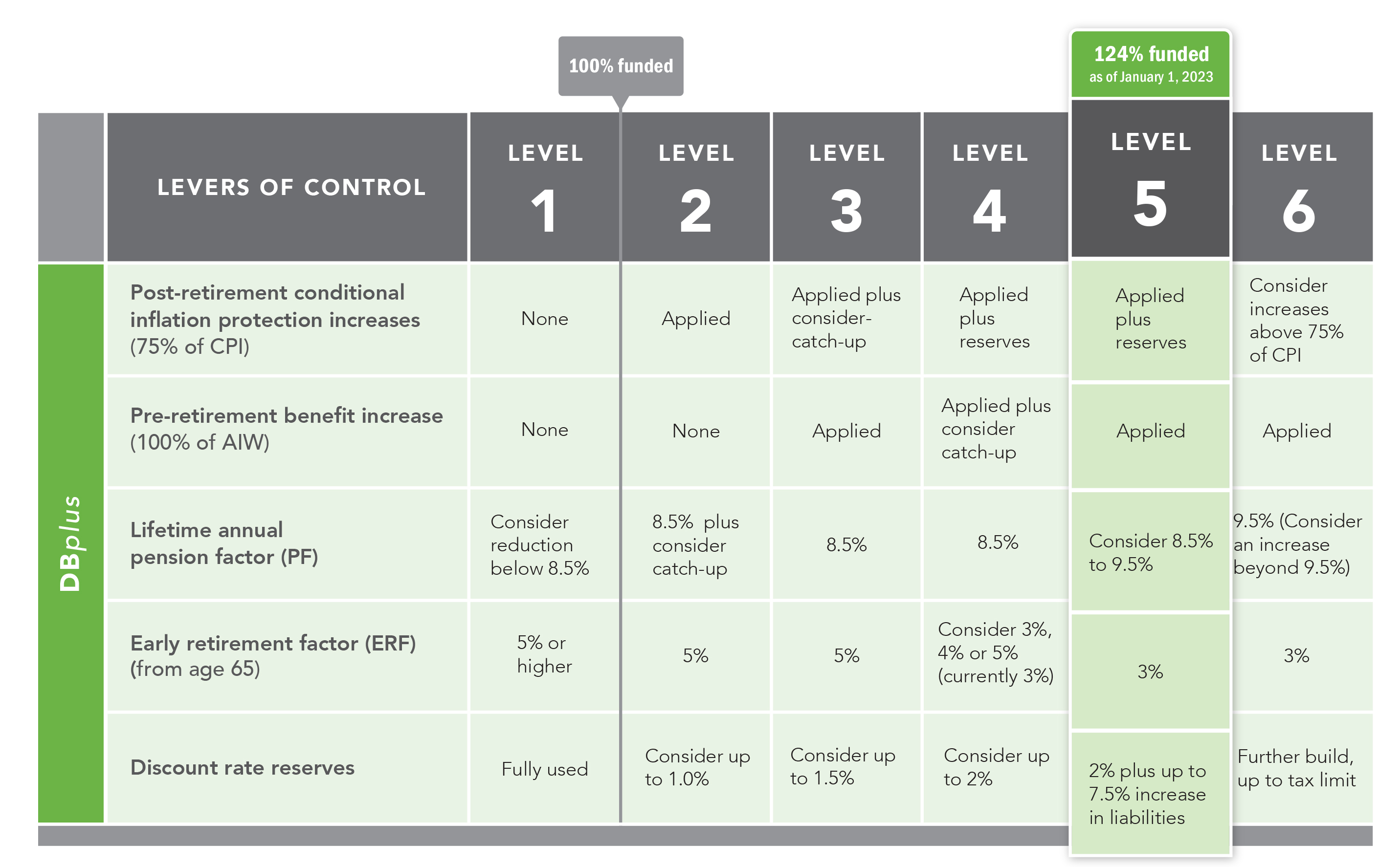
The CAAT Pension Plan Funding Policy defines six levels of Plan financial health and sets guidelines for the Plan governors to use reserves and conditional benefits to manage through periods of volatility, to keep the Plan sustainable over the long term to secure benefits while balancing fairness across the membership.
As the Plan rises through the levels in the Funding Policy, this can allow for enhancements to your pension. Similarly, if reserve levels decrease, conditional benefits may be paused. You can see the Funding Policy summary and read more on how the policy impacts various benefit features on CAAT’s website.
A change in funding level does not affect the percentage you or Molson Coors contribute to the Plan.
Retirement
Yes. Under DBplus, you can choose to retire as early as age 50. If you retire early, your pension will be adjusted with a reduction to account for the early start – unlike starting your pension at age 65, which would be unreduced. The adjustment rate varies based on the Plan’s funding level.
Different early retirement provisions apply to members who start their pension after being deferred members. Learn about these provisions on CAAT’s website.
If you stop working or leave your job after age 50, you have the following options:
- You can transfer your CAAT Plan pension to another Canadian registered pension plan if you start working for another employer that does not participate in the CAAT Plan so long as your new employer’s plan will accept the transfer. You have this option up until age 65.
- Start collecting your pension immediately, or anytime prior to age 65, subject to CAAT’s early start adjustment; or
- Wait until age 65 and receive an unreduced pension, with no early start adjustment. During this deferral period, your pension continues to grow annually with CAAT’s conditional enhancements.
If you decide to leave your benefit in the Plan and begin working for another employer that participates in the CAAT Plan, you may be required to resume contributing to the Plan as soon as your employment starts. Make sure your new employer knows you’re a member of the CAAT Pension Plan. If you’re required to resume contributing to the Plan, the appropriate member and employer contributions will begin, and you can resume accruing a pension immediately.
You can continue working and contributing to the Plan past age 65 without any interruption to your membership. You would simply continue to work, make contributions to the Plan, and watch your pension grow. However, as mentioned above, pursuant to the Income Tax Act, by November 30 of the year in which you turn 71, you will have to stop contributing to the Plan and start collecting your pension by December 1 of that year, even if you continue working.
Yes, CAAT will continue to pay you your regular monthly pension if you retire abroad. If you spend time during the year abroad, your pension payment will continue to be deposited into your Canadian bank account. Even if you relocate to another country permanently, you can choose to use the direct deposit service to a Canadian bank – or you can have your cheque (in Canadian funds) mailed to your foreign address.
Please note that the income tax deducted from your employment and government pensions may be affected by your new country of residence. The Canada Revenue Agency offers a variety of information that you should investigate before you leave.
CAAT only makes direct deposits to Canadian accounts. For a fee, you may be able to arrange with CAAT’s custodian, CIBC Mellon, to have your pension wired for deposit to your foreign account. Please be aware that your bank may also charge a fee for processing the wire transfer. Contact CIBC Mellon if you wish to pursue this.
Alternatively, you can request that your pension be paid by cheque, or have your pension deposited into a Canadian bank and access the account from abroad.
Survivor Benefits
Yes, your CAAT pension comes with survivor benefits that are applied based on your jurisdiction of employment and your individual situation at the time of your death.
The default survivor benefit is 60% of your pension and is not conditional on funding. However, when you retire, you have the option to reduce your pension permanently in exchange for a survivor benefit higher than 60%.
For detailed survivor benefit information visit Survivor Benefits on the CAAT website.
Termination Benefits
All CAAT Pension Plan members are entitled to a pension at retirement. If you leave your employment, you will have choices to make about the pension you earned during your membership.
When you terminate employment before your normal retirement date at age 65, you will stop contributing to the CAAT Pension Plan and enter an extension of membership (‘EOM’) period. Your CAAT membership will be automatically extended for 24 months from the date of your last contribution to the Plan.
During this time, you and Molson Coors will stop making contributions and your pension will keep growing with conditional AIW enhancements. You will not be able to withdraw your pension but you may be eligible to resume contributions at another CAAT-participating employer or transfer your pension to a non-CAAT employer’s pension plan. You can find more details about these options on CAAT’s website.
At the end of the 24-month period, you gain additional options, including keeping your pension in the CAAT Plan or transferring the commuted value* of your benefit out of the Plan provided you are not eligible for an immediate pension (age 50 and over). If you are eligible for an immediate pension, you may start your pension at any time during or after the 24-month period.
*The commuted value is the value of the pension you have earned in the Plan if it was paid out in a lump sum.
If you terminate your employment with your employer, you and your employer will stop making contributions and you will not have the option to keep contributing to DBplus. However, if you choose to keep your pension in the CAAT Pension Plan (see Q#29 for more details) you may still be able to participate in GROWTHplus (see Q#17 for information about GROWTHplus).
Purchasing Additional Pension
When you make a purchase in DBplus, you are adding an additional amount of pension to your lifetime pension. The purchased amount becomes part of your total pension – it will grow with conditional AIW increases while you work, and when you retire, it will be paid to you for the rest of your life. The cost of a purchase will vary because each purchase relates to a specific period – either a leave or a past period of employment. The amount of pension you receive will also vary, depending on how close you are to your normal retirement date.
Once you are enrolled in DBplus, you may be able to purchase additional DBplus pension.
Please note, as stated in the Collective Agreement between CUBGW Local 325 and Molson Coors: No transfer of assets from the Molson Canada Pension Plan for Hourly Employees in Ontario and Atlantic Canada will be made during the life of this collective agreement. If there is a wind up of the DC portion of the Molson Canada Pension Plan for Hourly Employees in Ontario and Atlantic Canada, the Employer will cooperate with allowing all legally permissible transfers to be made into CAAT from Members’ DC accounts that are affected by the wind up.
In general, you may be able to purchase additional pension in DBplus if you have an eligible period of employment with:
- Molson Coors for a period before joining the CAAT Pension Plan (also referred to as a pre-enrolment period) where you didn’t participate in a registered pension plan.
- A prior employer that does not participate in the CAAT Plan, where you belonged to a registered pension plan (as long as the benefits were transferred out).
- A prior employer that participates in the CAAT Plan, where you transferred your benefit out and no longer have a defined benefit pension entitlement for that period.
Only funds from a registered retirement vehicle (e.g., LIRA, RRSP) can be used to purchase this additional pension in DBplus. The amount a member can contribute for a purchase is limited by the Income Tax Act to 18% of cumulative T4 earnings (excluding taxable benefits) for a pre-enrolment period being purchased.
When you are enrolled in DBplus, you will receive additional information about the Plan including a member handbook and detailed steps for purchasing additional pension. CAAT also provides educational sessions on this option.
You can also learn more about pension purchases on CAAT’s website.
Once you’re enrolled in DBplus, you can purchase additional pension in DBplus so long as you have an eligible period of employment to purchase and you are an active member of the Plan at the time of your purchase request.
Visit the CAAT website for more information about the pension purchase process.
Yes. Your purchased DBplus pension grows with the same conditional AIW enhancements as your regular DBplus pension while you are actively employed. Once retired, your purchased DBplus pension will grow with the same conditional inflation protection as your regular pension (75% of the Consumer Price Index, or CPI).
GROWTHplus is a separate account for your personal tax-sheltered savings. With GROWTHplus you can grow your savings together with the secure defined benefit (DB) DBplus pension you have with CAAT. GROWTHplus is in addition to your lifetime pension and does not replace or change the pension you earn. Deposits to GROWTHplus are optional and your employer does not contribute to it like they do with your CAAT DB pension.
In comparison, when you make a purchase in DBplus, you are adding an additional amount of pension to your lifetime DB pension. This means the amount of pension you purchase becomes part of your total lifetime DB pension.
Visit the CAAT website for more information about GROWTHplus.
Have more questions?
Contact the CAAT Pension Plan by phone at 1-866-350-2228 (toll-free) or 416-673-9000 (Toronto area), or by email at member@caatpension.ca. Identify yourself and your employer, and CAAT’s representatives will help you with your pension-related questions.
DBplus Funding Policy